
LeoVegas
| License | United Kingdom — Gambling Commission account number 39198. Licensee: LeoVegas Gaming PLC. The operating company is registered in Sliema, Malta (company number C59314). |
|---|---|
| Rating | 7.4/10 |
| Operating since | 2012 |
| Min deposit | £5 (Apple Pay) / £10 |
| Withdrawal | up to 5 business days |
18+ · Terms and conditions apply · Play responsibly
Payments
-
 Visa
Visa -
 Mastercard
 -
 PayPal
 -
 Open Banking
 -
 Apple Pay
Pros
- The UKGC account number is in the terms and matches the regulator's own register — 39198, LeoVegas Gaming PLC, with leovegas.co.uk listed Active
- Welcome offer winnings are withdrawable, stated in those words on the offer page — free-spin winnings are more often bonus funds with wagering attached
- Disputes go to IBAS by name, with postal address, email and phone in the terms, where most operators write "an independent dispute resolution service"
- Dormant accounts return the balance: after 365 days without a login, anything over £1 goes back to the last payment method used
- Verification is required before betting, not only before withdrawing — the order that separates a compliant operator from a complaint magnet
- Six active domains on the licence and not one registered as a white label, in a market where 370 of 1,067 active domains are
- The offer names the exact game and the exact spin value: Big Bass Splash, 10p a spin, so the fifty spins are £5 of play
- Deposit and withdrawal limits are published per method, which most operators leave to a help article: Open Banking withdraws up to £35,000, Apple Pay £8,000, debit card £5,000
- Seven safer-gambling tools are documented with worked numerical examples, and spend, loss and wagering limits apply across all six LeoVegas Group brands at once
- Twelve game providers are identifiable in the public lobby without an account, Evolution and Pragmatic Play among them
- All six LeoVegas Group brands sit under one UKGC account — 39198 — in the regulator's own domain register, so a limit set at one is a limit set at the licence
Cons
- A payout cap applies "regardless of the amount you stake and no matter how much you appear to have 'won'". £250,000 for sport; for casino the terms give no figure and send you to each game's rules
- No credit cards — and that extends to digital wallets funded by one, so a PayPal balance topped up from a credit card is refused too
- The operating company is in Sliema, Malta (C59314). The licence is British, the counterparty is not
- Free spins expire 3 days after crediting. Claim on a Friday, do not log in over the weekend, and they are gone
- The casino payout cap is the one figure still not published: the terms give £250,000 for sport and send casino players to each game's own rules
- Customer support is one page with two links — live chat and a help centre. No phone number, no email address, no opening hours anywhere on it
- Every deadline that binds the customer is a number; every deadline that binds the operator is "a reasonable period". Verification and investigations have no stated limit
- A time-out has to be set separately on each sister site, even though spend, loss and wagering limits propagate across all six automatically
- The payments page carries an unfilled CMS placeholder in production: "contact our support team or email (ADD EMAIL)"
- Clause 10.2(j) lists "if you become bankrupt" as a Prohibited Practice, in the same list — and with the same stated consequences — as using a stolen card
- Using a payment method that is not in your name is prohibited "irrespective of whether you have the payment method owners authority to do so" (10.2(c))
This review is built from one place: what LeoVegas publishes about itself. That means the terms and conditions in full — all 59,831 characters — the welcome offer page, and the UK Gambling Commission’s public register, which is open data anyone can download.
Where those documents are silent, this page says they are silent rather than borrowing a number from somewhere else. There are four such gaps, and they are listed at the end.
The rating, and where it comes from
Five dimensions, each scored on what can be verified rather than on impression. A dimension where the operator publishes nothing is capped, because an unverifiable claim is not a good one.
| Dimension | Score | Why |
|---|---|---|
| Licence and transparency | 9 / 10 | Account number published and matching the register; the Maltese company disclosed rather than buried |
| Bonus terms | 8 / 10 | Winnings withdrawable and the qualifying game named; the 3-day expiry is short |
| Payments and fairness | 7 / 10 | Limits published per method, minimums and a timeframe stated; the casino payout cap still is not, and the page ships a CMS placeholder |
| Disputes and protection | 9 / 10 | IBAS named with full contact details, verification before betting |
| Games and providers | 7 / 10 | Twelve providers and the category structure verified in the public lobby; no total game count published |
| Safer gambling | 8 / 10 | Seven tools with worked examples and cross-brand limits; the time-out does not propagate like the rest |
| Customer support | 4 / 10 | Live chat and a help centre. No phone, no email, no hours published anywhere |
The composite is 7.4 / 10. It moved down from our first pass, not up: the payments and games scores both rose once the operator’s own pages were found, and adding customer support as a dimension pulled the average below where the five original dimensions left it.
What changed since the first version of this page
The games row said not rated and the payments row said four material
figures were unpublished. Both were wrong, and in the same way: we had read the
terms and the footer and concluded the operator was silent, when the operator
had a page we had not found. /payment-methods is not linked from the footer.
It is in the sitemap.
That page publishes the accepted methods, the minimum deposit, the minimum withdrawal and the payout timeframe — three of the four things we said were missing. The games row closed the same day, by reading the public lobby with a UK connection, which needs no account.
We are leaving the correction visible rather than quietly editing the rows. A review that never says it was wrong is a review nobody checked.
The licence, verified in both directions
Clause 2.2 states it plainly:
We are licensed and regulated by the Gambling Commission of Great Britain under account number 39198 in respect of customers located in the United Kingdom.
How to check that yourself, in a minute
The Gambling Commission publishes its register as open data. Four CSV files cover the whole picture:
business-licence-register-businesses.csv— the licensees, by account numberbusiness-licence-register-domain-names.csv— every domain, with Active or inactive statusbusiness-licence-register-trading-names.csv— the brand names each licensee operates underbusiness-licence-register-licences.csv— the individual licences and their activities
Account 039198 is held by LeoVegas Gaming PLC. The domain
leovegas.co.uk appears with status Active. The number on the site and the
number in the register are the same one.
This is the floor a UK casino should clear, and it is worth knowing that it can be checked — an account number in a footer is a claim, the register is the record, and they do not always agree.
The company behind it is Maltese
The same clause gives the address: Sliema, Malta, registered company number C59314.
This is neither unusual nor a problem with the licence. The UKGC regulates what is offered to customers in Great Britain regardless of where the company sits, and most large UK-facing operators are structured this way. It is worth knowing anyway, because it is the entity you contract with: the licence is British, the counterparty is not.
The payout cap
This is the clause that changes how everything else should be read, and LeoVegas itself flags it — it sits in the “Important Information” block at the top of the terms, among the clauses the operator says “have the potential to seriously affect your interests”.
Maximum Payout Limits: maximum payout limits apply to some of the Services. This means that, regardless of the amount you stake and no matter how much you appear to have ‘won’, you will only be entitled to receive up to the maximum winnings limit applicable to the relevant Service you have participated in or bet on.
The quotation marks around ‘won’ are the operator’s own punctuation. They are doing real work: they mark the gap between what the screen shows and what you are entitled to be paid.
For sport, the number is given
£250,000. Stated in the same clause, no hunting required.
For casino, it is not
The terms tell you to “refer carefully to the applicable Service rules to check whether any payout limits apply”. That means the cap on a slot session is in that slot’s own rules, not in the contract.
It is an honest position in the sense that it does not pretend there is no cap. It is an unhelpful one in practice:
- The number a slots player would want is not where the sports number is
- It is scattered across individual game rules
- Which means it is found after the fact, not before
A cap you have to hunt for, game by game, is functionally a cap you discover afterwards. This is the single biggest gap between what LeoVegas publishes and what a player needs.
Bonus terms
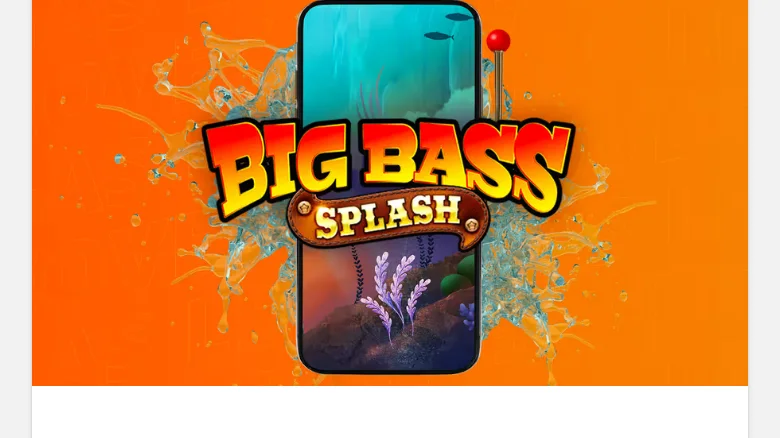
The offer page leads with the game rather than the number — Big Bass Splash, the Pragmatic Play slot the spins are locked to
The welcome offer, item by item
- What: 50 free spins on Big Bass Splash, a Pragmatic Play slot
- To qualify: deposit £10 or more within 7 days of registration and wager 1× on eligible casino games within 7 days
- Below £10: does not qualify, and the offer is removed — stated explicitly
- Spin value: 10p each
- Winnings: withdrawable, and the lobby calls them “Wager-Free Free Spins”
- Expiry: 3 days after crediting
- Contributions: “wagering contributions vary” — no table of which games count how much
⚠️ The wagering step is not on the promotions page. The offer page says deposit. The legal line under the same offer in the casino lobby says deposit and wager 1× on eligible games within seven days. Both are LeoVegas pages, published at the same time, and only one of them is complete. One times is a low bar — but a player who reads only the promotions page does not know there is a bar at all.
What it is actually worth
Fifty spins at 10p is £5 of play. The headline number is larger than the money behind it — true of most free-spin offers, and stated here more plainly than most.
The part worth reading twice is the withdrawable winnings. Free-spin winnings are more commonly credited as bonus funds with a wagering requirement attached, and the difference between the two is the difference between a promotion and a gift. LeoVegas says withdrawable, on the offer page, in those words.
The expiry is the weak point
Three days is short. Claim on a Friday, do not log in over the weekend, and the spins are gone. Offers with a 7-day window are common in this market.
The conditions, as the offer page prints them
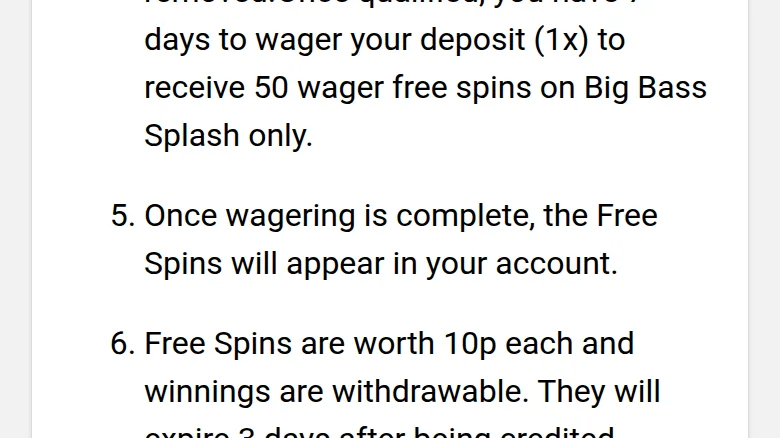
Conditions 4 to 6, verbatim: seven days to wager the deposit once, fifty wager-free spins on Big Bass Splash only, worth 10p each, winnings withdrawable, expiring three days after being credited
Everything this review says about the offer is on that one screen. Publishing the spin value and the expiry next to the headline is unusual, and it is what lets a reader work out that fifty spins is five pounds of play before they deposit rather than after.
The offer page carries its own FAQ
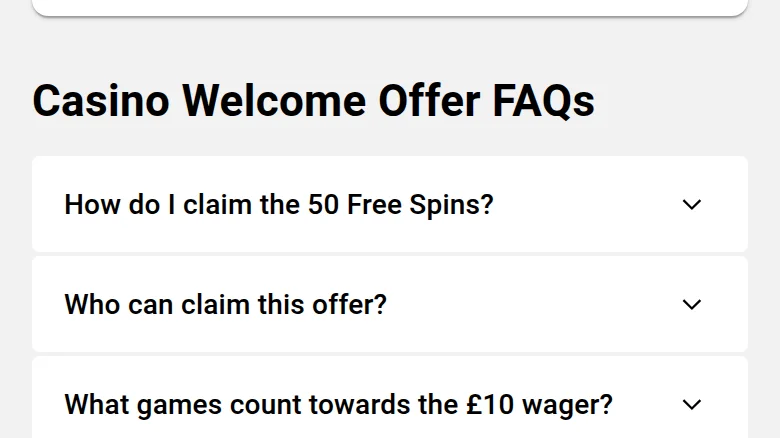
Three of the questions are the three a new player actually asks — how to claim, who is eligible, and which games count towards the £10 wager. The third is the one whose answer the terms leave as “wagering contributions vary”, so the FAQ is the only place it is addressed at all.
A second offer, and what it costs to enter
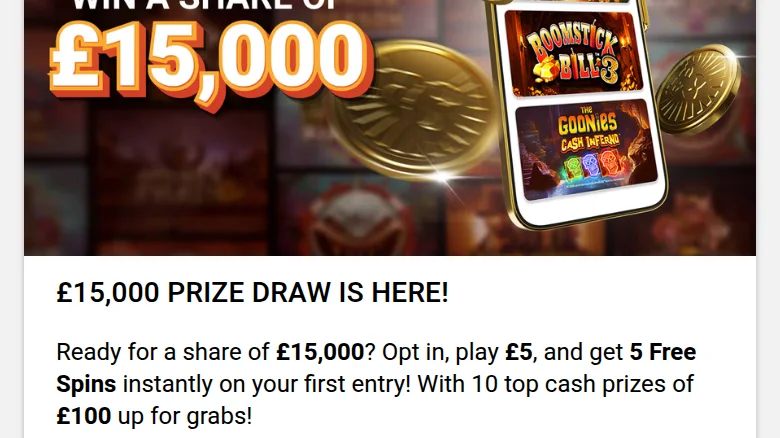
Running alongside the welcome offer, a prize draw: opt in, stake £5, receive five free spins on first entry, with ten top cash prizes of £100 from a £15,000 pool.
What the arithmetic says
A £15,000 pool sounds large next to a £5 entry. Ten prizes of £100 is £1,000 of the £15,000 named, and the page does not say how the rest is distributed or how many entrants there are. That is not a criticism of this draw in particular — it is how prize draws are advertised across the industry — but the number in the banner is a pool, not an expectation.
The five free spins are the certain part
They arrive on first entry, and they are the only part of the offer that does not depend on a draw. Judged as “stake £5, get 5 spins”, it is a small, honest reload. Judged as “share of £15,000”, it is a lottery ticket.
Account rules that catch people out
No credit cards, and the sentence that catches people
Clause 9.7:
We do not accept the use of credit cards. This means you may not use any credit card to deposit funds into your Account. This includes depositing into your Account via a Digital Wallet, where the original source of the deposited funds is a credit card.
The first sentence is UK law — the Gambling Commission banned credit-card gambling in April 2020, so every UKGC licensee says something like it.
The second sentence is not law, and is where people get caught: a digital wallet topped up from a credit card is refused as well. If your PayPal balance came from a credit card, that deposit is not eligible either.
Verification comes before betting
we will need to complete our verification Checks before you can do certain things in connection with your Account, including placing bets or wagers or withdrawing funds. We may also run Checks on an ongoing basis after your Account has been opened.
The order is the point:
- Verification at deposit — what the regulator expects, and what this operator states
- Verification only at withdrawal — the pattern behind most complaints in this industry, where a large win triggers checks that could have run earlier
LeoVegas states the first and reserves the right to re-run checks later. What it does not state is how long checks take, or which documents satisfy them.
Dormant accounts return the balance
Clause 13 is clear and in the customer’s favour:
- An account is Dormant after 365 consecutive days without a login
- If the balance is over £1, LeoVegas will attempt to contact you using your registration details
- The balance goes back to the last payment method you deposited with, where possible
Some operators charge dormancy fees against a sleeping balance. This one commits to returning it, in the contract rather than in a help article.
The rules that can cost you the balance
Clause 10 is the part of any operator’s terms that decides what happens when something goes wrong, and it is the part almost no review reads. LeoVegas calls these Prohibited Practices, and states the consequences in the first paragraph: voided transactions, “the withholding of any attributable winnings”, and suspension or closure of the account. Clause 10.4 goes further — you agree to compensate the operator for losses it incurs.
Twenty-four practices are listed. These are the ones a normal player can trigger without meaning to.
Being outside the UK, including with a VPN
if you are accessing (or attempting to access) the Services whilst located in any territory other than the United Kingdom (including if you use a VPN or any similar technology to disguise your location)
That is clause 10.2(a), and it is the easiest one on the list to break by accident. A British customer on holiday in Spain who opens the app to check a balance is, on the wording, accessing the Services from another territory. The VPN clause is aimed at deliberate evasion; the territory clause is not limited to it.
This is standard across UK licensees — geographic restriction is a licence condition, not a LeoVegas invention. What is worth knowing is that it sits in the same list, with the same stated consequences, as fraud.
Paying from an account that is not yours
Two separate clauses. 10.2(c): using a payment method not in your name, “irrespective of whether you have the payment method owners authority to do so”. 10.2(h): if the name on the account does not match the name on the payment method. A joint account, a partner’s card, a parent paying — the permission of the owner is explicitly not a defence.
Becoming bankrupt
Clause 10.2(j) lists, among the prohibited practices, “if you become bankrupt”.
Not gambling while bankrupt, not concealing it — becoming it. It sits in a list whose stated consequences include withholding winnings, between using a stolen card and manipulating bonuses. Whatever the intent behind the drafting, a customer reading the contract is told that an insolvency they may not have chosen is treated in the same clause as fraud.
What counts as “manipulating bonus functionality”
Clause 10.6 defines it, which is more than most operators do — a term left undefined is a term that means whatever the operator later says it means. Three behaviours:
- “Tier 2” strategy — staking first on a game that contributes little or nothing to wagering, then moving the winnings to a game that does
- Delaying a game round until after the wagering requirement is met or new funds are deposited. This explicitly covers holding an unplayed bonus round or free-spin feature
- Equal, zero or low margin bets, or hedge betting
The second is the one to watch. Triggering a bonus round and not playing it out until the wagering is cleared is a thing players do without thinking of it as strategy. Here it is named.
One account per brand — but six brands
Clause 6.1: “You may only open one Account per Brand.” Per brand, not per company. The same licensee runs six British sites, so six accounts are permitted under this clause while a second LeoVegas account is a Duplicate Account.
The consequences of a duplicate are graded, which is fairer than a flat rule. Clause 6.2.1 closes the extra account and voids promotions and any winnings from them. But 6.2.3 goes to the balance itself: if the operator determines the duplicate was opened deliberately or fraudulently, it may “retain all or part of the positive balance”.
Reading it against the safer-gambling page
Put the two documents side by side and a shape appears that neither states on its own:
| Crosses the six brands? | |
|---|---|
| Spend, loss and wagering limits | Yes, automatically |
| Self-exclusion | Yes |
| Account limit (one per brand) | No — six accounts allowed |
| Time-out | No — set it six times |
The protections that need the operator to act propagate. The two that need the player to act — opening fewer accounts, taking a short break — do not. We are not suggesting that is deliberate. We are pointing out that a player who assumes “the group handles it” is right about half the time, and the half they are wrong about is the half that needs them to notice.
Closure with fourteen days’ notice
Clause 11.1: the operator may close an account “at any time for any reason” on no less than fourteen days’ written notice. A no-reason termination right with notice is normal in consumer contracts of this kind. It is worth knowing it exists before it is used.
Disputes go to IBAS, by name
The terms name the adjudicator and publish three ways to reach it:
- IBAS — Independent Betting Adjudication Services Limited
- PO Box 62639, London EC3P 3AS
- ibasteam@ibas-uk.co.uk
- +44 20 7347 5883
Most operators refer to “an independent dispute resolution service” without saying which, leaving the customer to find it. Naming IBAS with a postal address and a phone number is a materially lower-friction promise, and it is the kind of detail that only shows up if you read the contract rather than the marketing.
Games and providers
This is the section we could not write in the first version. It needs no account — the UK lobby renders its catalogue to anyone with a British connection, and the footer publishes the category structure.
The providers, named
Twelve studios are identifiable in the public lobby: Pragmatic Play, Play’n GO, NetEnt, Evolution, Red Tiger, Playtech, Blueprint Gaming, Hacksaw Gaming, Push Gaming, Games Global, Quickspin and Iron Dog Studio.
That is the live-verified list, not a marketing claim — each was read from the lobby the site serves to a British connection, with no account.
| Studio | What its presence tells you |
|---|---|
| Evolution | Live dealer. The category exists at all because of this deal |
| Pragmatic Play | Big Bass Splash — the game the welcome offer is tied to |
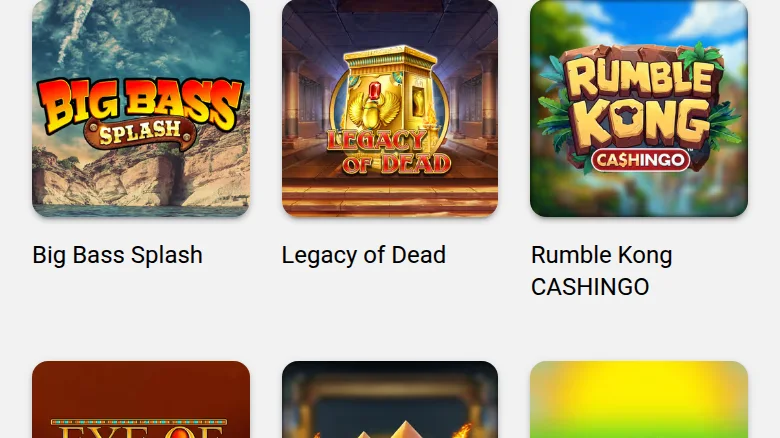
| Play’n GO | Legacy of Dead, Book of Dead. The UK’s most recognised slot names |
| Red Tiger, Games Global | Daily-drop jackpot networks, which need scale to be worth running |
| Hacksaw, Push Gaming, Nolimit-tier studios | High-volatility titles; a lobby without them reads as dated |
| Playtech, Blueprint | Branded and land-based conversions — Eye of Horus, The Goonies |
| Quickspin, Iron Dog | Smaller studios. Their presence means the deal list is not just the majors |
The names on the tiles are the ordinary British lobby: Big Bass Splash, Legacy of Dead, Eye of Horus, 12 Masks of Fire, The Goonies Cash Inferno, Cash Strike Fire Lock. Nothing exotic, and that is the point — this is a mass-market lobby, not a specialist one.

The popular room, with an EXCLUSIVE flag on one tile in the row below
New releases get their own room

The site explains what the room is for in its own words, and the explanation is better than most:
The aim of this page is to help you spot what is new first, then move into the wider category if you want to browse more games of the same type.
What the lobby copy claims for itself
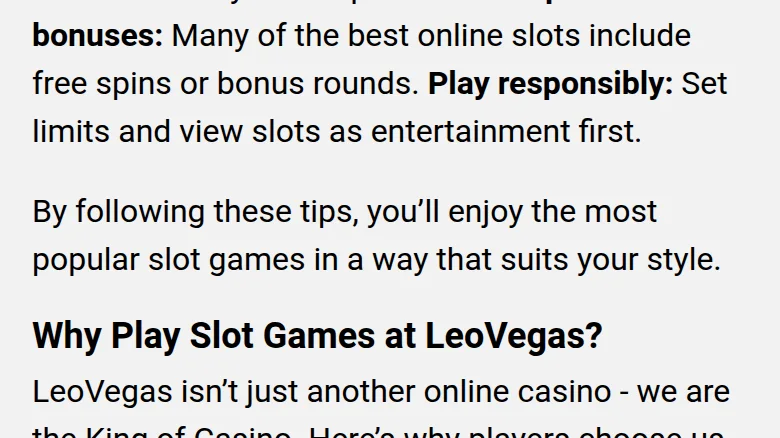
The slots page carries several hundred words of the operator’s own copy, including a responsible-play line — “Set limits and view slots as entertainment first” — placed inside the marketing rather than in a footer. It costs nothing to write and most lobbies do not bother.

Jackpots: two networks and one that is theirs
King Millions, and why three games show the same number
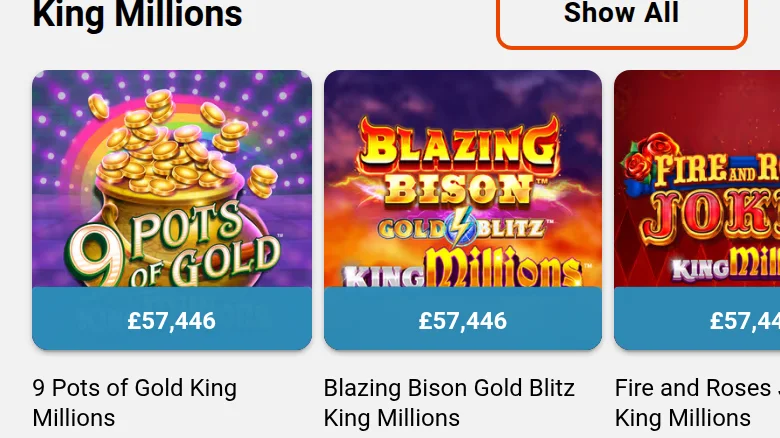
Look at the figure on the three tiles: £57,446 on all three. That is what a network jackpot looks like from the outside. King Millions is a shared pool that pays from whichever game triggers it, so the number is identical across every game in the network — and identical at every other casino that installs it.
⚠️ The corollary is worth stating plainly: that money is not LeoVegas’s to pay. A network jackpot figure is a supplier’s pool. It is a real prize, and it is the same real prize at a dozen other sites.
LeoJackpot is the one that is theirs
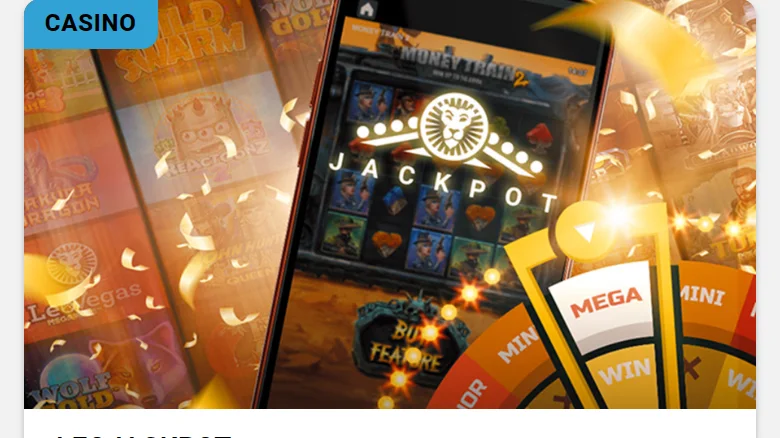
The operator promotes a jackpot under its own name, and the lobby page lists which games feed it.
A house jackpot is a different proposition from a network one: the pool is smaller, the field is smaller, and the operator is the counterparty. Neither is better — but knowing which one you are playing changes what the number on the tile means.
The live casino, and what “exclusive” means here
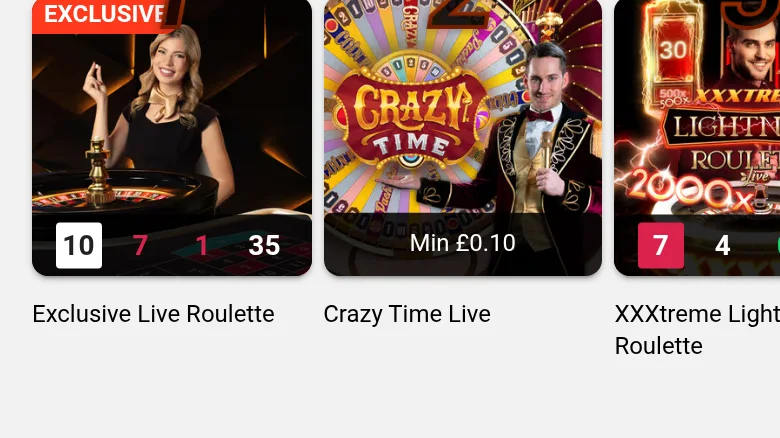
The minimum stake is on the tile
Min £0.10 appears on the Crazy Time and Family Feud tiles before you open them. Publishing the table minimum in the lobby is a small thing that saves a player from opening six tables to find one they can afford.
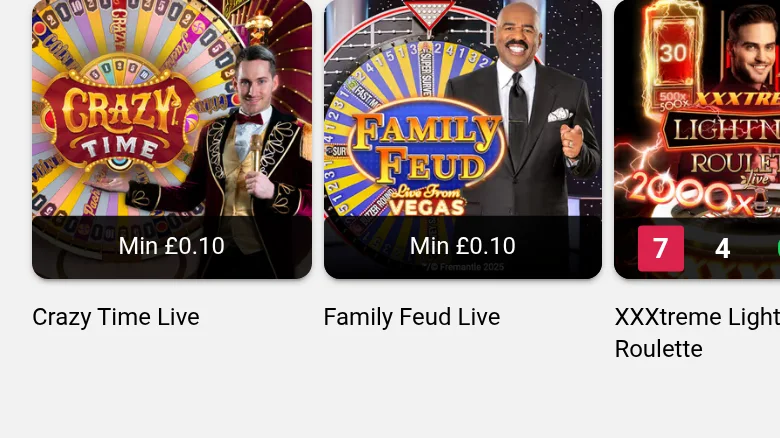
The game shows are Evolution’s
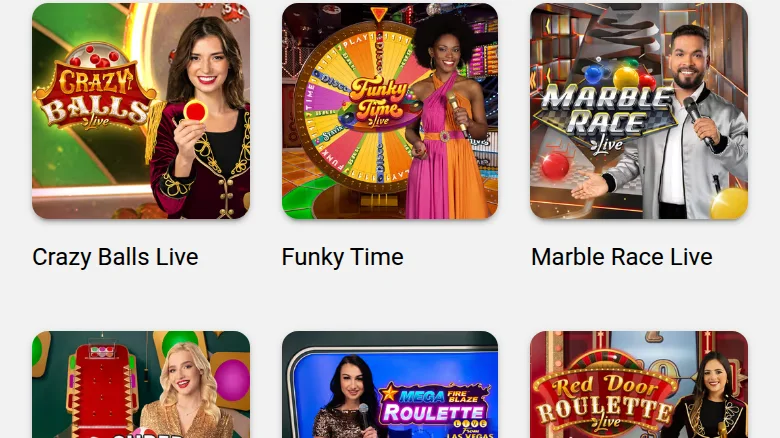
Crazy Balls, Funky Time, Marble Race, Mega Fire Blaze Roulette, Red Door Roulette — the game-show shelf is Evolution’s almost end to end, as it is at nearly every operator that carries it.
The exclusive tables
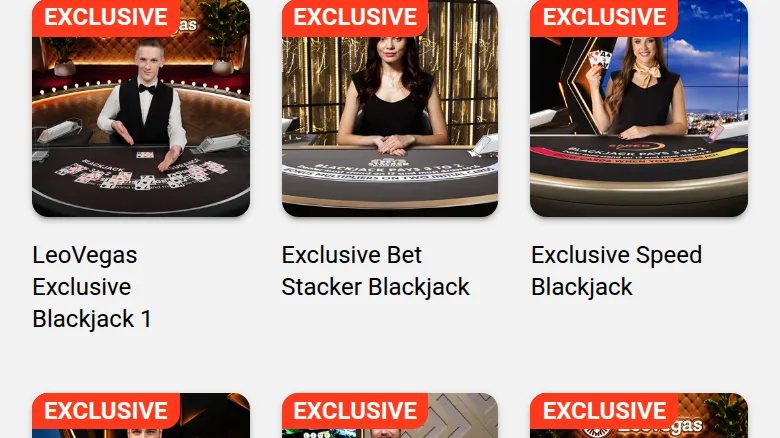
A whole room of tables flagged EXCLUSIVE, branded to the operator. What “exclusive” means in live casino is a dedicated table in the supplier’s studio rather than a different game — the rules and the RTP are the supplier’s. What you get is a smaller table and the operator’s branding on the felt.
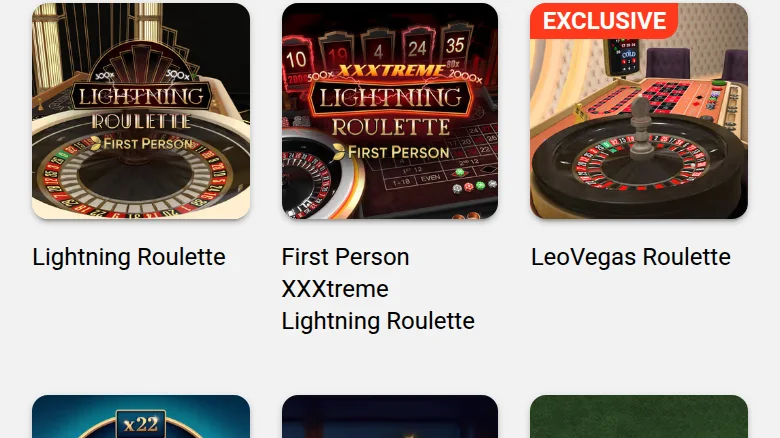
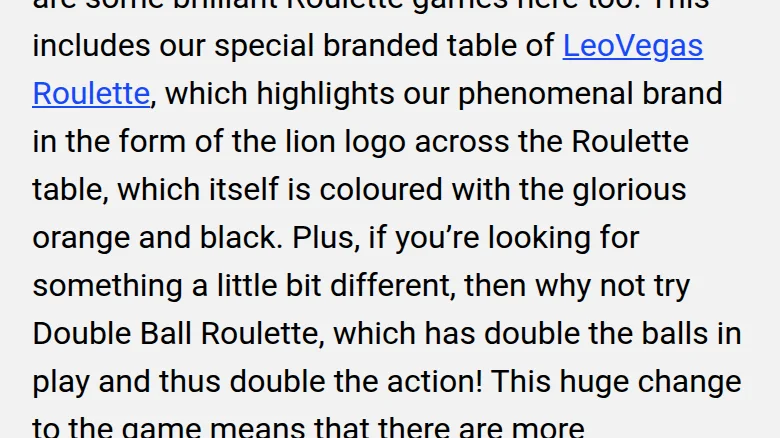
The operator describes the branded table itself — “the lion logo across the Roulette table, which itself is coloured with the glorious orange and black” — which is an honest way of saying that the difference is cosmetic.
The structure, from the operator’s own footer
| Casino | Live casino |
|---|---|
| New games, Slots, Jackpots, Top games | New games, Table games, Blackjack |
| Megaways, Bingo, Table games | Game shows, Roulette, Poker, Card games |
| Instant win, LeoJackpot | Live LeoJackpot, LeoVegas Exclusive |
LeoVegas Exclusive is the row that matters: an exclusive live table is a commercial arrangement with Evolution that a small operator cannot get. It is also unverifiable from outside — we can see the category exists, not what is in it.
What is still not published
No total game count. Most operators put a number in the hero — “2,000+ games” — and LeoVegas does not, anywhere we could find. We counted 187 distinct game tiles in the public lobby, which is what the front page loads, not the size of the library. We are not turning that into a catalogue figure.
The awards, and their dates
The operator’s own About Us page lists seven awards, and the dates are the interesting part:
| Year | Award |
|---|---|
| 2024 | Online Casino of the Year — Global Gaming Awards (EEMA) |
| 2023 | Mobile Operator of the Year — International Gaming Awards |
| 2023 | Operator of the Year — EGR Operator Awards |
| 2023 | Casino Operator of the Year — EGR Operator Awards |
| 2022 | Online Gaming Operator of the Year — International Gaming Awards |
| 2022 | Online Casino of the Year — Global Gaming Awards |
| 2021 | Best Mobile Casino Product — EGR Operator Awards |
Four of the seven are from 2022 or earlier, and the most recent is from 2024 — two years old at the time of writing. Either the operator stopped winning, or it stopped updating the page. We cannot tell which from outside, and neither can a reader, which is the problem with an undated awards list presented as current.
The same page gives the founding year: 2012.
The apps
iOS and Android, both named, with the full catalogue also available in a phone browser. What the page does not give is a version number, a store rating, a download count or a size — the four things that make an app claim checkable. “King of mobile casino” is the operator’s phrase; the App Store and Play Store listings are where it would be verified, and the page does not link to either.
Money in and money out, with the numbers
The operator publishes limits per method. That is unusual enough to be worth saying plainly: most sites of this size push it into a help article, or state a single site-wide minimum and leave the rest to the cashier.
| Method | Min deposit | Max deposit | Min withdrawal | Max withdrawal |
|---|---|---|---|---|
| Debit card | £10 | £1,000 | — | £5,000 |
| PayPal | £10 | £1,000 | — | — |
| Apple Pay | £5 | £1,000 | £10 | £8,000 |
| Open Banking | £10 | £10,000 | £10 | £35,000 |
Payouts take up to five business days depending on method — the operator’s own wording, on the same page.
Reading the table
Open Banking is the outlier by a factor of four. £35,000 out against £8,000 for Apple Pay and £5,000 for a debit card. If you ever expect to withdraw a large win, the method you deposited with is the method you are usually paid back to, and that choice is made before you know whether you will need it.
Apple Pay has the lowest entry at £5, half of everything else.
Mastercard is listed without the word debit. Clause 9.7 refuses credit cards outright, including wallets funded by one. The payments page does not repeat the distinction, so a Mastercard credit card will be accepted by the page and refused by the processor.
The placeholder
One line on that page, in production, on a site licensed by the Gambling Commission:
If you have any further issues, players can also use the chat option to contact our support team or email (ADD EMAIL).
It is a content-management placeholder that was never filled. It is not a compliance failure and it costs nobody money. It is the kind of detail that tells you how closely the operator’s own information pages are read — which is the question this whole section is really about.
The safer-gambling tools
Seven tools, each documented with a worked numerical example. That is more than the regulator requires and more than most licensees write.
| Tool | Range |
|---|---|
| Spend limit | Daily, weekly, monthly — net of withdrawals |
| Loss limit | Daily, weekly, monthly |
| Wagering limit | Daily, weekly, monthly, across all bets |
| Session limit | Auto-logout at the set time |
| Reality check | 15, 30, 60 or 90 minutes |
| Time-out | 24 hours to 6 weeks |
| Self-exclusion | 6 months to 5 years |
Lowering a limit takes effect immediately. Raising one triggers a 24-hour wait and then asks you to confirm again. That asymmetry is the correct way round.
The one thing to know: what crosses brands, and what does not
LeoVegas Group runs six British sites — BetMGM, BetUK, LeoVegas, Pink Casino, 21.co.uk and Slotboss. Spend, loss and wagering limits apply across all six automatically. Self-exclusion does too.
That is not just a policy statement, and it is checkable without taking the operator’s word for it. All six domains sit under the same UKGC account number, 39198, in the regulator’s own domain register — betmgm.co.uk, betuk.com, leovegas.co.uk, pinkcasino.co.uk, 21.co.uk and slotboss.co.uk, each listed Active against LeoVegas Gaming PLC. They are one licensee wearing six front doors, which is why a limit set at one of them is a limit set at the licence.
A time-out does not:
If you want to apply a time-out on any other LeoVegas operated sites, you must do so from each site.
So the shortest break — the one you reach for on a bad evening, the one that exists precisely because you do not want to think about it — is the only one you have to remember to set six separate times. The long tools propagate; the emergency one does not. We have not seen another operator publish that asymmetry as clearly, and we have not seen one explain why it exists either.
Two more worth knowing
A time-out does not return your balance. “You may wish to withdraw any funds before you start a Time-Out, as your balance will not be automatically refunded to you once it begins.” Withdrawing during one means contacting support — the channel with no published response time.
Coming back is deliberately slow. Reactivation after self-exclusion needs live chat, then a phone call from the team, then a 24-hour cooling-off period before the account reopens. Three steps and a day. That is a good design.
GAMSTOP is named and linked, as it must be for a British licensee.
Customer support
The support page is two links: a help centre and live chat. That is the whole page.
No phone number. No email address. No opening hours. No published response time.
On most sites that is a minor complaint. Here it is not, because the operator’s own documents route so much through support: self-exclusion, reactivation, withdrawing money during a time-out, setting a loss limit if you would rather not do it yourself. Those are the moments when a player most needs a second channel, and there is only one — and a placeholder where the email should be.
Verification: what they ask, and what they can do while they wait
Clause 8 is where a deposit becomes a relationship. It is also where the complaints in this industry come from, so it is worth reading closely.
What registration asks for
Clause 8.1 lists six items: first and last name, residential address, date of birth, gender, a valid email and contact number, and a username and password.
Gender is the odd one. Name, address and date of birth are what the operator needs to satisfy its identity obligations; the other three are how it reaches you. Gender does neither. It is not a large thing, and it is collected by plenty of operators, but a contract that lists exactly six required fields invites the question of what the sixth is for.
You cannot bet until they have checked
You will not be permitted to gamble until we have verified your name, address and date of birth as we need to ensure you are who you claim to be.
That is 8.2, and it is the right way round. An operator that verifies at deposit is doing what the regulator expects. One that verifies only when a large withdrawal appears is the pattern behind most disputes in this industry — the customer plays for months, wins, and only then discovers the checks.
The documents
Clause 8.5 names them: a form of personal ID — passport or driving licence — and proof of address. The phrasing is “include, but are not limited to”, so the list is a floor rather than a ceiling.
⚠️ And the part with no clock on it
Clause 8.4 says that until the requested documents are received and the checks satisfied “to our reasonable satisfaction”, the operator may restrict the account “in any manner that we reasonably deem appropriate”, including preventing bets and temporarily preventing withdrawals.
If the checks cannot be completed to that satisfaction, or the operator cannot verify that you are who you say, that the payment method is yours, and that the funds are yours from a legitimate source, it “will ultimately close your Account and pass on any necessary information to the relevant authorities”.
Read clause 11.2 next to it. Where a Prohibited Practice is suspected, the account is suspended and stays suspended “while the matter is investigated”. The operator commits to “reasonable efforts to undertake our investigation within a reasonable period”.
Nowhere in the contract is that period a number. Not for verification, not for an investigation, not for a document review. Every deadline in the terms that binds the customer is exact — 7 days to qualify for the offer, 3 days before spins expire, 365 days to dormancy, 14 days’ notice of closure, 24 hours before a raised limit takes effect. Every deadline that binds the operator is “reasonable”.
That asymmetry is not unique to LeoVegas and it is not a breach of anything. It is simply the single most useful thing to know before your account is the one being investigated: the clock in the contract only runs one way.
If a Prohibited Practice is found
Clause 11.1 sets out what happens to the money. Where illegal activity is involved, the operator is “under no obligation to pay to you any money that may be in your Account”. Where a Prohibited Practice is found, it will withhold all or part of the balance and may “recover from your Account deposits, payouts, bonuses, and/or any winnings” attributable to it.
Note the word deposits. The recovery right is not limited to winnings or bonus money — it reaches the money you put in, to the extent it is attributable to the practice found.
Where LeoVegas sits in the British market
Context most reviews skip, because it needs the regulator’s data rather than the operator’s marketing. The Gambling Commission publishes its register as open data, and counting it changes what “one of the biggest UK casinos” means.
| Domains listed Active | 1,067 |
| Companies behind them | ~480 |
| Companies with a single active domain | 307 (64%) |
| Domains registered as White Label | 370 |
Two companies — Jumpman Gaming and ProgressPlay — account for 237 of those 370 white labels. Nearly two thirds of the white-label market in Great Britain runs on two platforms.
Against that, LeoVegas Gaming PLC holds one account number with six active domains, none of them white label. That is a genuine operator running its own brands, not a storefront on someone else’s platform, and it is a smaller club than the raw figure of “over a thousand licensed casinos” suggests.
⚠️ It is also why the shared-licence point earlier in this review matters more than it first reads. Six brands on one licence is not six competitors keeping each other honest. It is one company, one set of terms, and — as the safer-gambling section shows — one set of limits, whether the player realises it or not.
What LeoVegas still does not publish
The one figure that is still not published:
| Status | |
|---|---|
| Casino payout cap | deferred to each game’s own rules |
Every other row of that table has now been filled from the operator’s own pages. The casino cap has not. The terms state a cap exists and give £250,000 for sport; for casino they point at each game’s rules, and each game’s rules are behind the game. It is the one number where a player cannot find out the answer before depositing.
How we reviewed this
- Sources: the operator’s terms and conditions in full (59,831 characters), the casino welcome offer page, and the UK Gambling Commission’s public register
- Not used: other review sites, aggregator databases, or any figure we could not trace to the operator or the regulator
- Checked: 4 September 2026. Bonus terms change; the licence status can be re-checked against the register at any time using the account number above
- Not verified: the contents of the LeoVegas Exclusive live tables, the app store listings, and support response times — no figure is published for any of them, and none is scored above
- On the shape of this page: it runs about 600 characters per heading. Our Japanese reviews run at half that, because Japanese affiliate pages are built in short blocks and readers there expect it. The five UK rivals we measured sit at 691. Fragmenting this page further would import a format from a market that does not use it — the section count follows the market, not a house rule
If you find something on this page that the operator’s own documents contradict, that is a bug and we want to know.
Frequently asked questions
Is LeoVegas licensed in the UK?
Yes, and the number is verifiable in about a minute. Clause 2.2 of the terms states: "We are licensed and regulated by the Gambling Commission of Great Britain under account number 39198 in respect of customers located in the United Kingdom." The Commission publishes its register as open data — CSV files covering businesses, domains and licences. Account 039198 belongs to LeoVegas Gaming PLC, and leovegas.co.uk is listed with status Active. The number on the site and the number in the register are the same one.
Is there a maximum amount LeoVegas will pay out?
Yes, and the wording matters. The terms say maximum payout limits apply to some services, and that "regardless of the amount you stake and no matter how much you appear to have 'won', you will only be entitled to receive up to the maximum winnings limit applicable to the relevant Service". The quotation marks around 'won' are the operator's own. For sports betting the figure is given: £250,000. For casino and everything else, the terms give no number — they tell you to check each game's own rules. So there is a cap on slots; it just is not written where the sports cap is written.
Can I deposit with a credit card at LeoVegas?
No, and the exclusion is wider than it first reads. Clause 9.7: "We do not accept the use of credit cards. This means you may not use any credit card to deposit funds into your Account. This includes depositing into your Account via a Digital Wallet, where the original source of the deposited funds is a credit card." The first sentence is UK law — the Gambling Commission banned credit-card gambling in April 2020, so every licensee says something like it. The second is the one that catches people: a wallet topped up from a credit card is refused as well.
When does LeoVegas check my identity?
Before you can bet, not only before you can withdraw. The terms say verification checks must be completed "before you can do certain things in connection with your Account, including placing bets or wagers or withdrawing funds", and that checks may also be run on an ongoing basis afterwards. The order is the point. An operator that verifies at deposit is doing what the regulator expects; one that verifies only when a large withdrawal appears is the pattern behind most complaints in this industry. What the terms do not say is how long checks take or which documents satisfy them.
What happens to my account if I stop using it?
It becomes Dormant after 365 consecutive days without a login. If the balance is over £1 at that point, clause 13.2 says LeoVegas will attempt to contact you using your registration details and return the balance to the last payment method you deposited with, where possible. Some operators charge a dormancy fee against a sleeping balance; this one commits to sending it back, and says so in the contract rather than in a help article.
What is the welcome offer, and are the winnings withdrawable?
Fifty free spins on Big Bass Splash, a Pragmatic Play slot. To qualify you deposit £10 or more within 7 days of registration; the offer page states that deposits below £10 will not qualify and the offer is removed. Each spin is worth 10p, so the fifty spins are £5 of play, and the page says the winnings are withdrawable. That last point is the one to read twice — free-spin winnings are more commonly credited as bonus funds with wagering attached, and the difference between the two is the difference between a promotion and a gift. The spins expire 3 days after being credited.
Who do I complain to if something goes wrong?
IBAS — Independent Betting Adjudication Services Limited. The terms give three ways to reach it: PO Box 62639, London EC3P 3AS; ibasteam@ibas-uk.co.uk; +44 20 7347 5883. Naming the adjudicator and publishing its contact details is more than most operators do — many refer only to "an independent dispute resolution service" and leave the customer to find out which one.
How long does LeoVegas take to pay out?
Up to five business days, and the operator does publish it — on the payment-methods page rather than in the terms: "depending on your chosen method, it can take up to five business days for the funds to appear in your account". We had this down as unpublished in our first pass and were wrong; the page is not linked from the footer, only from the sitemap. The terms give the rule rather than the clock — you "will usually be able to withdraw your available real money balance at any time, but there are certain circumstances in which we are required by law to delay or reject withdrawals" — and the two documents do not contradict each other. What is still missing is a per-method breakdown: five business days is the outer bound for all of them together.
What payment methods does LeoVegas accept, and what are the limits?
Six methods, listed on the operator's own payment-methods page: Visa Debit, Visa Electron, Mastercard, PayPal, Apple Pay and Open Banking. The limits are published per method, which is more than most operators do. Debit card: £10 minimum deposit, £1,000 maximum, withdrawals up to £5,000. PayPal: £10 to £1,000 in. Apple Pay: £5 minimum — the lowest of the four — up to £1,000 in, and £10 to £8,000 out. Open Banking has the widest range by a distance: £10 to £10,000 in, and £10 to £35,000 out. Note that Mastercard is listed without the word debit, while clause 9.7 of the terms refuses credit cards entirely; the page does not resolve that, and a Mastercard credit card will be declined.
What safer-gambling tools does LeoVegas offer?
Seven, each documented with a worked example: spend limit, loss limit, wagering limit, session limit, reality check (15, 30, 60 or 90 minutes), time-out (24 hours to 6 weeks) and self-exclusion (6 months to 5 years). Lowering any limit takes effect immediately; raising one triggers a 24-hour wait and a second confirmation. The detail worth knowing is what crosses brands and what does not. Spend, loss and wagering limits apply automatically across all six LeoVegas Group sites — BetMGM, BetUK, LeoVegas, Pink Casino, 21.co.uk and Slotboss — and self-exclusion does too. A time-out does not: the page states you "must do so from each site". So the shortest break is the one you have to remember to set six times.
How long can LeoVegas hold my account while it verifies me?
The contract does not say, and that is the answer worth having. Clause 8.4 lets the operator restrict the account — including temporarily preventing withdrawals — until the requested documents are received and the checks are satisfied "to our reasonable satisfaction". Clause 11.2, for a suspected Prohibited Practice, promises "reasonable efforts to undertake our investigation within a reasonable period". No number appears in either. Now compare the deadlines that bind you: 7 days to qualify for the welcome offer, 3 days before the free spins expire, 365 days to dormancy, 24 hours before a raised limit applies, 14 days' notice if they close your account. Every one of those is exact. The asymmetry is normal across this industry and is not a breach of anything — but it is the single most useful thing to know before yours is the account being checked.
What can get my LeoVegas account closed or my winnings withheld?
Clause 10 lists twenty-four "Prohibited Practices", and states the consequences up front: voided transactions, "the withholding of any attributable winnings", and suspension or closure. Clause 10.4 adds that you agree to compensate the operator for losses it incurs. Most of the list is what you would expect — stolen cards, collusion, bots, inside information. Three are worth knowing because an ordinary player can trigger them without meaning to. Accessing the site from outside the UK, including with a VPN (10.2(a)) — which catches a British customer opening the app on holiday. Depositing from a payment method not in your own name, and the terms say the owner's permission is no defence (10.2(c)). And, listed among them, "if you become bankrupt" (10.2(j)).
What does LeoVegas count as abusing a bonus?
Clause 10.6 defines it, which is more than most operators do — an undefined term means whatever the operator later decides it means. Three behaviours count. First, "Tier 2" strategy: staking on a game that contributes little or nothing to the wagering requirement, then moving the winnings to one that does. Second, delaying a game round until after the wagering is met or new funds are deposited — and this explicitly includes holding an unplayed bonus round or free-spin feature. Third, equal, zero or low margin bets, and hedge betting. The second is the trap: sitting on a triggered bonus round until the wagering clears is something players do without thinking of it as a strategy at all.
Can I have accounts at more than one LeoVegas Group brand?
Yes. Clause 6.1 says one account per **brand**, not per company, and the same licensee — UKGC account 39198 — runs six British sites: BetMGM, BetUK, LeoVegas, Pink Casino, 21.co.uk and Slotboss. A second LeoVegas account is a Duplicate Account; an account at each of the six is not. The consequences of a genuine duplicate are graded: 6.2.1 closes it and voids promotions and winnings from them, while 6.2.3 allows the operator to "retain all or part of the positive balance" where it determines the duplicate was opened deliberately or fraudulently. Note the asymmetry with the safer-gambling tools: spend limits and self-exclusion follow you across all six automatically, but the account limit does not, and neither does a time-out.
How do I contact LeoVegas customer support?
Live chat, or the help centre. That is the entire contact page: two links, no phone number, no email address, and no opening hours. The safer-gambling pages repeatedly tell you to contact support — to self-exclude, to reactivate an account, to withdraw during a time-out — which makes the absence of a published response time or a second channel more material than it would be on a site that never routed anything through support. The payments page does gesture at an email address, but the placeholder was never filled: it reads "contact our support team or email (ADD EMAIL)" in production.
Spec source: www.leovegas.co.uk · Updated on 2026-09-06
Responsible gambling
Slots are games of chance and high volatility can drain a balance fast. Set deposit limits and never gamble money you can’t afford to lose. If it stops being fun, get help.
18+ BeGambleAware: 0808 8020 133 (UK). 18+ only.